
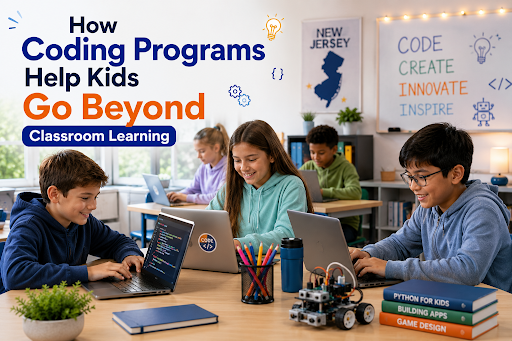
How Coding Programs Help Kids Go Beyond Classroom Learning
Technology is transforming the way children learn, create, and solve problems. While traditional classroom education provides a strong academic foundation, it often leaves limited room for hands-on digital skills that today's world demands. This is where coding programs for kids make a remarkable difference. They introduce children to real-world problem-solving, creativity, and innovation in ways that textbooks alone cannot.
Today's children are growing up in a digital-first world. Instead of simply consuming technology, they should understand how it works and even learn to build it. Whether it's designing games, creating websites, programming robots, or developing simple apps, coding opens doors to endless opportunities. More importantly, it teaches children how to think rather than what to think.
Parents are increasingly recognizing the importance of enrolling their children in coding classes for kids because these programs go far beyond academics. They encourage curiosity, confidence, teamwork, and resilience while preparing young learners for future careers in technology.
If you're wondering how coding programs help kids learn, this guide will show why coding has become one of the most valuable skills children can develop outside the classroom.
Why Classroom Learning Alone Isn't Enough Today
Schools play a vital role in educating children, but today's fast-changing world requires much more than memorizing facts or passing exams. Employers increasingly seek individuals with creativity, adaptability, collaboration, and problem-solving abilities.
Traditional classrooms often follow fixed curricula, leaving little room for experimentation or project-based learning. As a result, many students miss opportunities to explore their interests in technology and innovation.
That's why parents are turning toward after school coding programs, where children can apply concepts through hands-on projects while developing confidence in a supportive environment.
What Are Coding Programs for Kids?
Coding programs for kids are structured educational courses that teach children how computers work and how to create software using beginner-friendly programming languages and tools.
These programs are designed according to different age groups and learning levels. Instead of overwhelming children with technical concepts, instructors use games, animations, storytelling, robotics, and creative projects to make learning enjoyable.
From simple block-based coding platforms to advanced programming languages like Python, these coding courses for kids gradually build technical knowledge while keeping learning fun and interactive.
Coding Turns Kids from Technology Consumers into Technology Creators
Most children spend hours using smartphones, tablets, video games, and apps every day. But coding teaches them something much more valuable—they become creators instead of just users.
Imagine your child designing their own game instead of simply playing one. Or creating a website rather than only browsing websites. This shift encourages creativity, innovation, and independent thinking.
With consistent coding lessons for kids, children begin seeing technology as something they can shape rather than something they merely consume.
Builds Strong Problem-Solving Skills
One of the greatest benefits of coding programs for kids is the development of problem-solving abilities.
Every coding project involves challenges. Programs may not run correctly the first time, errors appear unexpectedly, and solutions often require multiple attempts. Instead of giving up, children learn how to analyze problems, test ideas, and improve their work.
This logical approach becomes valuable not only in coding but also in mathematics, science, and everyday decision-making.
Encourages Critical Thinking and Logical Reasoning
Coding teaches children to think systematically.
Before writing code, they must understand the problem, break it into smaller steps, and organize those steps logically. This process strengthens computational thinking—a skill that supports academic success across many subjects.
As children continue developing coding skills for kids, they naturally become more confident in analyzing situations and making informed decisions.
Makes Learning More Creative
Many people assume programming is only about writing code, but creativity plays an equally important role.
Children can design animations, build interactive stories, create games, develop websites, and even produce digital art. Coding becomes another creative medium, much like painting or music.
This combination of technical and creative thinking makes computer programming for kids both exciting and highly engaging.
Improves Confidence Through Project-Based Learning
Children feel proud when they build something themselves.
Completing a game, animation, or robot gives them a sense of accomplishment that boosts self-confidence. Even when projects don't work initially, overcoming obstacles teaches persistence.
Unlike traditional assignments that end with grades, coding projects provide visible achievements children can proudly share with family and friends.
Strengthens STEM Learning
Modern education increasingly emphasizes Science, Technology, Engineering, and Mathematics (STEM), and coding naturally connects all four disciplines.
Many STEM coding programs combine programming with robotics, engineering challenges, AI, and scientific experiments. Children don't simply learn theory—they apply knowledge to solve real-world problems.
This hands-on approach makes STEM subjects more meaningful and enjoyable.
Develops Collaboration and Communication Skills
Coding isn't always an individual activity.
Many kids coding programs include pair programming, team projects, coding competitions, and collaborative challenges where children work together to achieve shared goals.
They learn how to communicate ideas clearly, accept feedback, divide responsibilities, and solve problems as a team—skills that are valuable throughout life.
Coding Supports Better Academic Performance
Coding strengthens many skills that directly benefit school performance.
Children improve logical reasoning, mathematical thinking, reading comprehension, sequencing, attention to detail, and analytical abilities. These improvements often transfer into classroom success because students become more organized and confident learners.
In many cases, coding education for children complements school learning rather than replacing it.
Encourages Independent Learning
One unique advantage of coding is that children quickly become self-directed learners.
When facing coding challenges, they naturally begin experimenting, researching solutions, and learning through trial and error. Instead of waiting for answers, they become active problem solvers.
This mindset helps children become lifelong learners capable of adapting to new technologies throughout their lives.
Why Online Coding Classes Are Becoming So Popular
Parents today appreciate the flexibility of online coding classes for kids because they combine expert instruction with the convenience of learning from home.
Live interactive sessions allow children to ask questions, receive immediate feedback, and collaborate with classmates from different locations. Online learning also saves travel time while providing access to experienced instructors.
Many families choose online programs because they offer personalized learning paths that match each child's pace.
The Value of Coding Workshops and Coding Camps
Short-term learning experiences also offer tremendous benefits.
Coding workshops for kids introduce children to exciting technologies such as game development, robotics, artificial intelligence, web design, and app creation.
Similarly, coding camps for kids provide immersive environments where students spend several days building meaningful projects while making new friends who share similar interests.
These experiences often spark long-term enthusiasm for technology.
Preparing Kids for Future Careers
The future workforce will rely heavily on digital skills.
Fields like artificial intelligence, robotics, cybersecurity, software engineering, game development, data science, and automation continue growing rapidly. Even careers outside technology increasingly require digital literacy.
When children learn coding for kids programs early, they gain a valuable head start that prepares them for future educational and career opportunities.
How Parents Can Support Coding Learning at Home
Parents don't need to be programmers to encourage coding.
They can celebrate completed projects, ask children to explain what they've built, encourage curiosity, provide time for creative exploration, and support consistent practice.
Positive encouragement helps children view mistakes as learning opportunities rather than failures.
Why Learnerbit Is an Excellent Choice for Young Coders
If you're looking for engaging and future-focused coding education, Learnerbit offers an outstanding learning experience designed specifically for young learners.
Join Learnerbit's online AI, coding and robotics courses for kids. Live interactive classes, hands-on projects and expert mentors for ages 6–16.
Learnerbit's curriculum combines coding, robotics, artificial intelligence, project-based learning, and personalized mentoring to help children develop practical skills while having fun. Whether your child is just beginning or already enjoys programming, Learnerbit provides structured learning pathways that encourage creativity, confidence, and innovation.
Conclusion
The world is changing faster than ever, and children need skills that extend beyond traditional classroom education. Coding programs for kids provide much more than programming knowledge—they develop creativity, critical thinking, collaboration, resilience, and problem-solving abilities that benefit children throughout their lives.
From interactive projects and robotics to game development and artificial intelligence, coding helps children discover how technology works while empowering them to create something meaningful themselves.
Investing in coding today is truly an investment in your child's future. With expert guidance, engaging projects, and supportive mentors, programs like Learnerbit make learning exciting while preparing young minds for tomorrow's digital world.
Frequently Asked Questions (FAQs)
1. What is the ideal age for children to start learning coding?
Most children can begin basic coding between the ages of 6 and 8 using visual programming platforms. As they grow, they can gradually move to text-based programming languages like Python and JavaScript.
2. How do coding programs help kids learn outside the classroom?
Coding encourages project-based learning, creativity, logical thinking, collaboration, and real-world problem-solving, giving children practical skills that traditional classrooms may not always provide.
3. Are online coding classes effective for kids?
Yes. High-quality online coding classes for kids offer live instruction, interactive projects, personalized feedback, and flexible learning schedules that make coding both engaging and effective.
4. Why is coding important for children's future?
Coding develops essential digital skills while preparing children for future careers in technology, engineering, artificial intelligence, robotics, and many other rapidly growing industries.
5. Why should parents choose Learnerbit?
Learnerbit combines live expert instruction, AI, robotics, coding, and hands-on projects in an engaging learning environment designed specifically for children aged 6–16, helping them build confidence and future-ready skills.